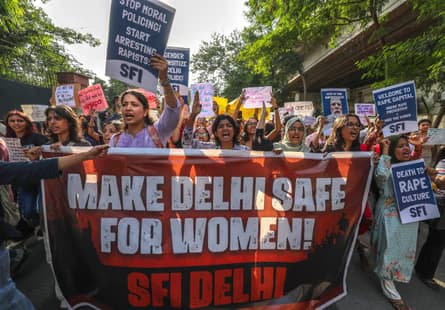
Hundreds of women have taken to the streets of Delhi, protesting a series of brutal rapes that have shaken university campuses across India. The demonstrations, fueled by outrage and a sense of persistent insecurity, highlight a stark reality: despite legislative changes and public outcry following past incidents, many women feel little has changed regarding their safety.
- Protests erupted following several recent rapes, including the alleged gang-rape of a 17-year-old in Delhi.
- Demonstrators cite a lack of progress since the infamous Nirbhaya case 14 years ago.
- Slogans demand accountability, stating, “Girls don’t need curfews, rapists need consequences.”
- Statistics indicate a rape occurs in India every 20 minutes, with under-reporting exacerbating the true scale.
Escalating Violence and Public Outcry
The current wave of protests was ignited by a series of deeply disturbing sexual assaults in recent weeks. Among the most shocking was the alleged gang-rape of a 17-year-old girl in a public park near Delhi University.
The perpetrators reportedly posed as police officers to lure the victim.
This incident followed another horrific event just a week prior, where another 17-year-old was allegedly gang-raped and murdered in Delhi’s Swaroop Nagar. Her body was discovered days later, partially consumed by animals, after she was stabbed to death.
Reports of rapes involving an 11-year-old and a six-year-old have also surfaced within the same month, underscoring a pervasive pattern of violence.
Echoes of the Nirbhaya Case
For many protesters, the recent events are a painful reminder of the Nirbhaya case, a brutal gang rape on a bus in Delhi 14 years ago that resulted in the victim’s death. Despite the international condemnation, subsequent legislative reforms, and government promises made in the wake of that tragedy, women argue that the fundamental safety situation has not improved.
“Fourteen years have passed since Delhi’s infamous Nirbhaya rape case… But while it provoked international outrage and a slew of legislation and government promises, women say nothing has changed; for them, India’s streets, particularly in Delhi, remain as unsafe as ever,” the Guardian reported.
Statistics Paint a Grim Picture
Official statistics paint a grim picture of the prevalence of sexual violence in India. According to available data, a woman is raped approximately every 20 minutes .
However, experts and activists widely believe that the actual number is significantly higher due to widespread under-reporting, a phenomenon often linked to societal stigma, fear of reprisal, and perceived failures in the justice system.
The Supreme Court itself has acknowledged the gravity of the situation, recently commenting on five successive rape cases that “starkly underlined a systematic failure.” The court noted the painful parallels to the Nirbhaya incident of 2012, suggesting that the systemic issues contributing to such crimes remain unresolved.
Student Activism and Demands
Student activists have been at the forefront of these protests, articulating a deep-seated frustration with the status quo. Vaishnavi Dhruw, a 21-year-old history student at Delhi University, shared her perspective during a recent protest march.
“I don’t know a single woman who lives in this city and feels safe,” Dhruw stated, encapsulating the pervasive sense of insecurity among women in Delhi. The protesters’ demands extend beyond immediate security measures, calling for a fundamental societal shift.
Calls for Societal Change
While immediate demands often include improved street lighting and more robust policing, activists like Dhruw stress that these are insufficient. They argue that a deeper, more profound societal transformation is necessary to address the root causes of gender-based violence.
The slogans seen at the protests, such as “Lock your dicks rather than your women at home,” reflect a growing impatience with victim-blaming and a demand for male accountability. The underlying message is clear: the responsibility for preventing sexual assault should not fall on women to protect themselves, but on society to ensure perpetrators are held accountable.
Systematic Failures and Legal Parallels
The recurring nature of these incidents has led to widespread criticism of the justice system’s effectiveness. The Supreme Court’s observation about “systematic failure” suggests a recognition at the highest levels that existing mechanisms are not adequately preventing or punishing sexual offenses.
The comparison to the Nirbhaya case is particularly telling, indicating that despite legislative efforts and increased public awareness following that landmark event, the underlying issues of societal attitudes towards women and the efficacy of law enforcement and judicial processes have not been sufficiently addressed.
Conclusion
The mass protests sweeping across Indian universities, particularly in Delhi, are a powerful testament to the enduring struggle for women’s safety and justice. Fueled by a series of horrific rapes and a profound sense of disillusionment, students are demanding accountability and systemic change.
The echoes of the Nirbhaya case serve as a stark reminder that legislative action alone is insufficient; a deep-seated societal shift is required to dismantle the structures that perpetuate gender-based violence and ensure that women can live without fear.
What triggered the recent protests in India?
A series of brutal rapes, including the alleged gang-rape of a minor, sparked widespread protests on Indian university campuses.
How does the current situation compare to the Nirbhaya case?
Protesters feel that despite legislative changes after the Nirbhaya case 14 years ago, women’s safety has not significantly improved.
What are the main demands of the protesters?
Demands include better lighting and policing, but crucially, a fundamental societal shift towards accountability for perpetrators.
What do the statistics suggest about rape in India?
Statistics indicate a rape occurs roughly every 20 minutes, though under-reporting is believed to make the true figure much higher.
What has the Supreme Court said about the recent cases?
The Supreme Court noted the cases “starkly underlined a systematic failure” and drew parallels to the Nirbhaya incident.