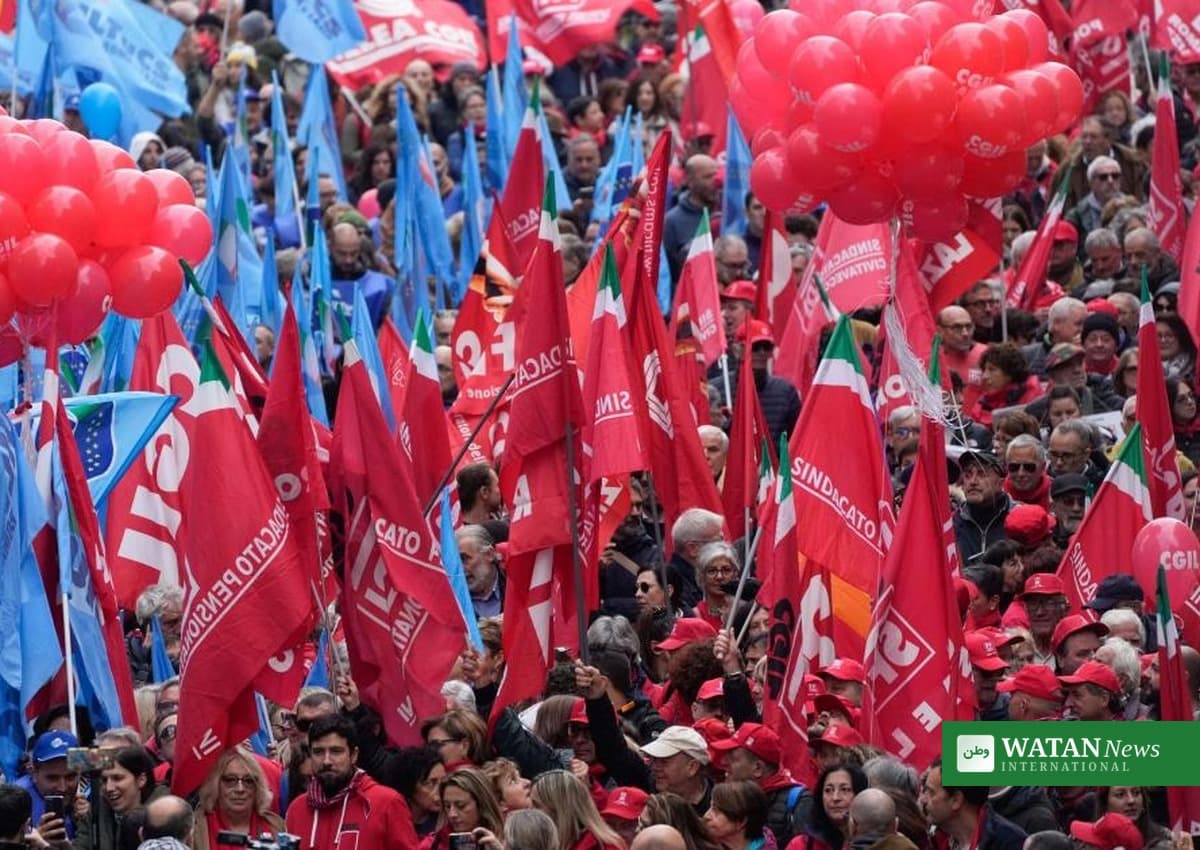
Tens of thousands of workers and students took to the streets across Italy on Friday in a nationwide general strike called by the country’s largest trade union, the CGIL, to demand higher wages and greater investment in public services.
Demonstrations were held in more than 100 cities, from Milan in the north to Naples, Palermo and Rome, as the 24-hour stoppage disrupted schools, health services and local transport. Addressing a rally in Rome, CGIL leader Maurizio Landini said more than one million people had taken part across the country.
The strike was directed at the economic policies of Prime Minister Giorgia Meloni’s government, and it came as parliament examines the proposed 2027 budget, worth €26 billion, which the union says does not do enough to support incomes or public services.
FAKTA
- What happened: A 24-hour general strike across Italy on Friday, 20 November 2026, with marches in more than 100 cities.
- Who called it: The CGIL, Italy’s largest trade union; grassroots unions including Cobas called separate strike action.
- What workers want: Higher wages, renewed contracts, full indexation of pensions and no increase in the retirement age.
- Transport: Air and rail were excluded from the general strike; local transport ran on minimum service. A separate rail strike ran from 21:00 on Friday until 20:00 on Saturday.
A day of stoppages across the country
The CGIL stoppage lasted the full working day and covered workers in both the public and private sectors, including in schools and healthcare. Local transport was reduced in several cities, although minimum-service rules limited the disruption.
Students joined the marches in large numbers as part of a Europe-wide day of student mobilisation. Student protests were also planned in Germany, France, Britain, Austria and Belgium, where young people raised concerns about living costs, housing and military spending.
Budget at the centre of the dispute
The union’s central complaint is the government’s draft budget for 2027. The CGIL argues that the €26 billion plan offers too little support for workers and public services, and that only a fraction of it is directed at younger generations.
The union is demanding wage increases and renewed contracts to restore purchasing power lost to inflation, alongside full indexation of pensions and measures to stop the retirement age from rising. Landini said ordinary families were struggling with basic expenses.
The government defended its plans. Industry Minister Adolfo Urso described the strike as premature, saying Landini had called it before knowing the contents of the budget. He added that parliament would work to improve the proposal through amendments.
Pressure builds ahead of the 2027 election
Friday’s action followed a nationwide mobilisation on 30 October, when thousands of students joined striking workers to demand more funding for education and relief from rising housing and living costs. The protests come as Italy prepares for a parliamentary election due in 2027, underlining the growing public pressure over wages, social spending and the government’s priorities.
Read more on Europe at Watan News.