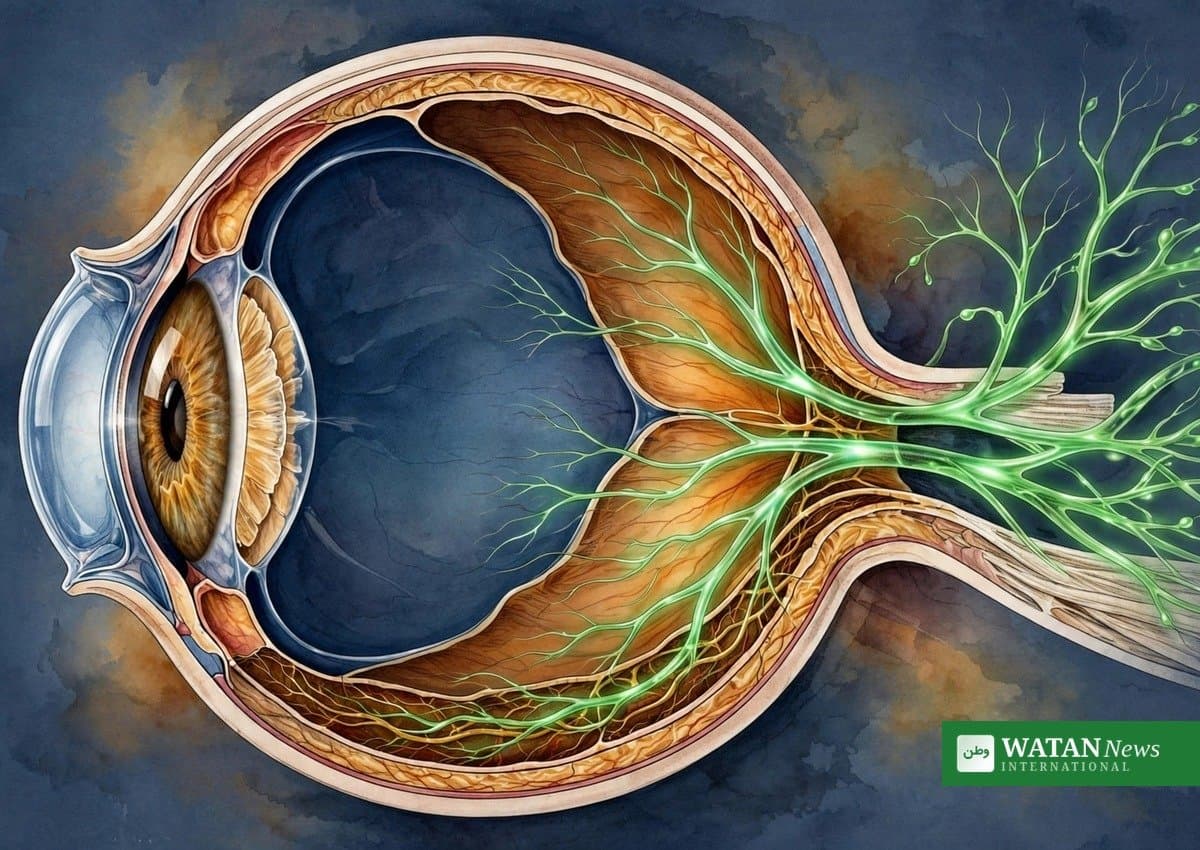
Scientists in Canada have identified a previously unknown eye lymphatic drainage route at the back of the human eye, a finding that overturns more than a century of scientific thinking about how the eye clears waste. The newly described pathway, named the posterior ocular lymphatic outflow — or POLO pathway — lets fluid and metabolic waste travel from the retina into the body’s lymphatic system. Researchers at the University of British Columbia and the University of Toronto say the discovery could open a new front in the fight against glaucoma and other leading causes of blindness.
FAKTA
- Discovery: the posterior ocular lymphatic outflow (POLO) pathway — a drainage network in the choroid layer beneath the retina that carries fluid and waste into the body’s lymphatic system.
- Researchers: teams at the University of British Columbia and the University of Toronto, led by Dr. Neeru Gupta and Dr. Yeni Yücel.
- Evidence: demonstrated in mice using fluorescent tracer molecules, magnetic resonance imaging and near-infrared fluorescence imaging; tracers reached nearby lymph nodes within minutes.
- Significance: challenges the 100-year-old assumption that the eye has no lymphatic drainage; a possible new target for studying glaucoma and age-related macular degeneration, which affects about 2.5 million Canadians.
- Caveat: shown in mice only so far; confirming it in humans and developing treatments will need further research.
Why the eye’s waste matters
Many leading causes of irreversible blindness share one feature: the buildup of fluid, waste and inflammatory debris at the back of the eye. The retina is among the most metabolically active tissues in the body, constantly producing byproducts that must be removed. Yet for decades, scientists could not fully explain how this delicate region cleared them. Finding the route the eye uses to flush waste away has therefore been one of ophthalmology’s long-standing puzzles.
How the eye lymphatic drainage was traced
To find the route, the teams placed fluorescent tracer molecules into the rear of the eye in mice and watched where they travelled. Using MRI and near-infrared fluorescence imaging, they observed the tracers moving through previously unrecognized lymphatic vessels in the choroid and reaching nearby lymph nodes within minutes — evidence of a direct link between the eye and the wider lymphatic network. The work extends an earlier discovery by the same researchers, who in 2009 identified a lymphatic drainage pathway in the front of the eye. For a field that had assumed for more than a hundred years that the eye had no lymphatic drainage, the result is a fundamental shift.
What comes next
The discovery is still at an early stage, and scientists must confirm the pathway works the same way in humans before any treatment can be considered. But the researchers say it offers a new framework for understanding blinding diseases — and a possible lever for future therapies that boost the eye’s own cleanup system. Read more health and science coverage on Watan News.