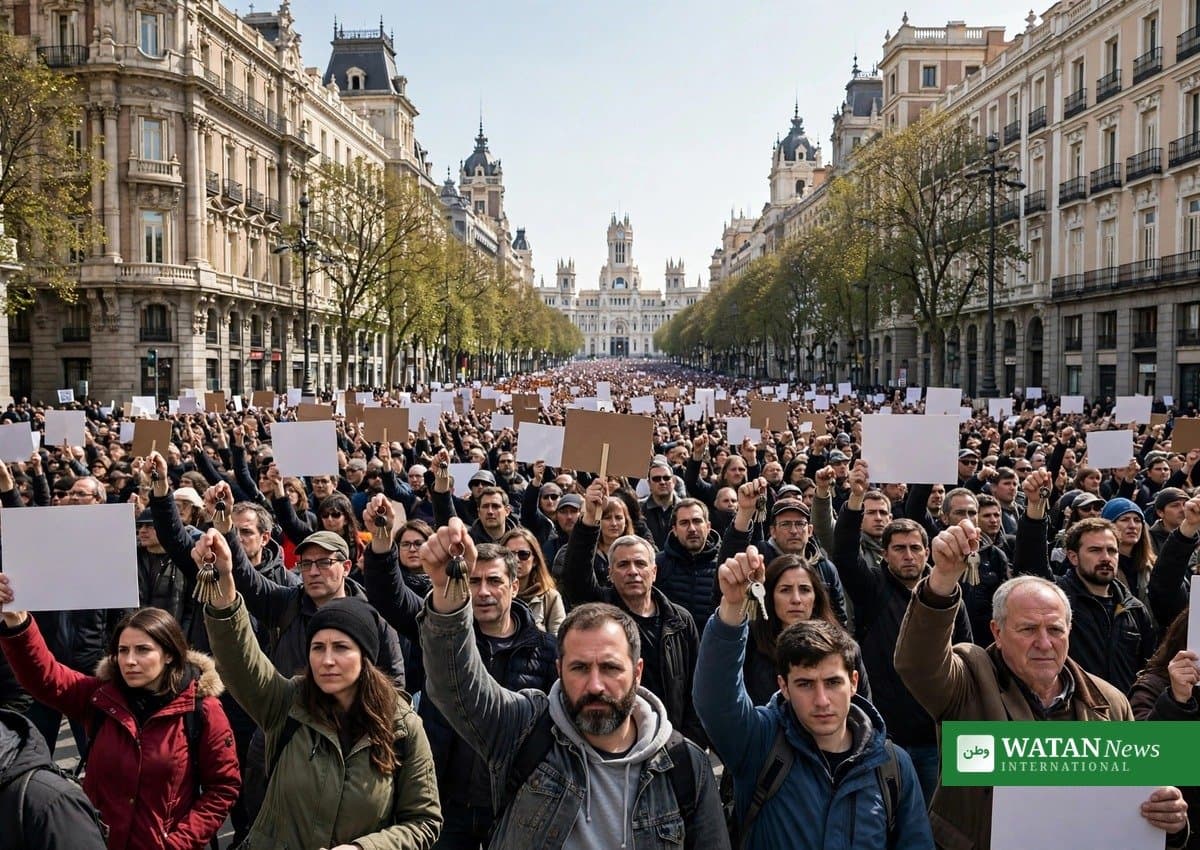
Tens of thousands of people marched across Spain on Saturday as the Spain housing protests escalated, one day after parliament rejected two government decrees aimed at protecting tenants. In Madrid, four columns of demonstrators converged on Plaza de Cibeles, with turnout estimates ranging from 70,000, according to the government delegation, to 500,000, according to the organizers.
FAKTA
- What: Mass demonstrations over Spain’s housing crisis in more than 50 cities on Saturday, 3 October 2026.
- Trigger: Parliament rejected two emergency housing decrees on Friday; weeks of anger after the eviction of 87-year-old Maricarmen Abascal in Madrid.
- Madrid: Four march columns converged on Plaza de Cibeles — 70,000 per the authorities, 500,000 per the Tenants Union.
- Valencia: Protesters breached barriers at the Palau de les Arts during a real estate investment summit; police used rubber bullets and tear gas. Nine officers injured, five people detained.
- Barcelona: The march was postponed because of heavy rain warnings.
- Next: The Tenants Union says a general strike will be called after talks with labour unions; Spanish media report Prime Minister Pedro Sánchez may call a snap election for November.
From One Eviction to a National Uprising
The face of the movement is 87-year-old Maricarmen Abascal, evicted on 23 September from the Madrid apartment where she had lived since 1956 — roughly 70 years. An investment firm had acquired the property and sought to raise her rent by 275 percent. After a wave of public outrage, the new owners agreed to let her return at a lower rent, but by then her case had become a national symbol of the housing crisis.
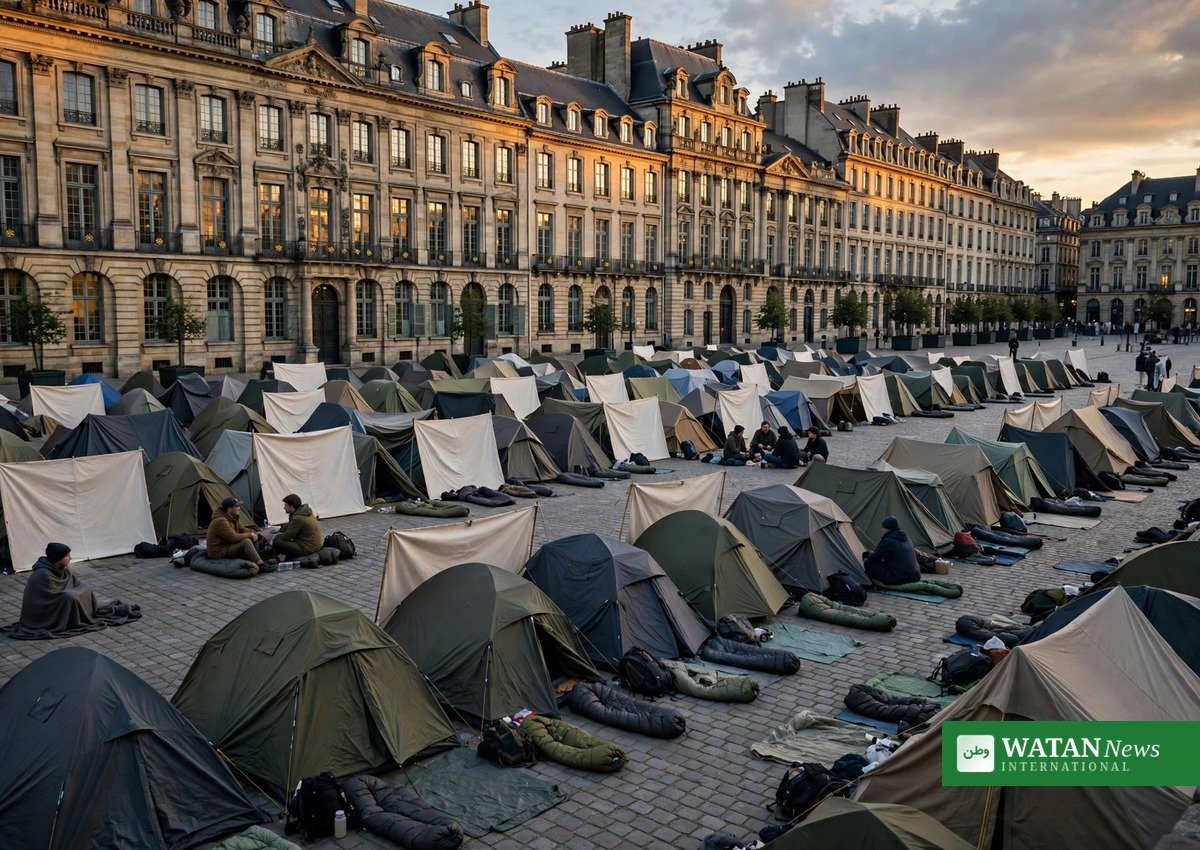
Days after the eviction, protesters began camping in Madrid’s Puerta del Sol square. By Saturday, more than 300 tents filled the square, and similar encampments had spread to other Spanish cities — a sustained, visible presence in the heart of the capital that set the stage for the weekend’s marches.
Saturday’s Marches: Madrid, Valencia and More Than 50 Cities
In Madrid, demonstrators marched in four columns from different parts of the city — the northern column from Glorieta Emilio Castelar, the southern from Atocha, the eastern from near Hospital de La Princesa and the western from Plaza de España — before converging on Cibeles Square under the slogan “Towards the general strike”. Organizers put turnout at 500,000, while the government’s delegation counted 70,000. Many marchers raised and rang house keys, a gesture that has become the movement’s symbol.
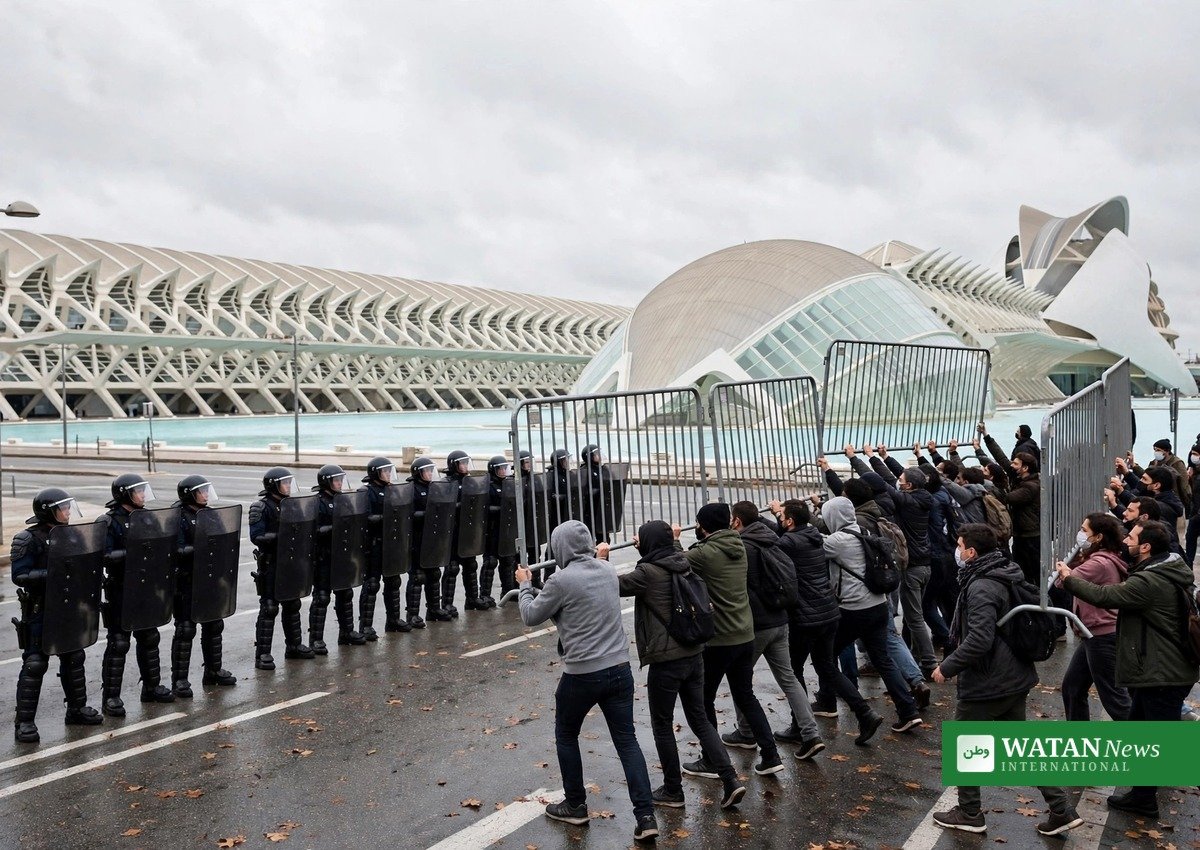
The day’s most serious clashes came in Valencia, where the march ended at the Palau de les Arts while the Valencia Real Estate Summit 2026 — a real estate investment congress — was under way inside. Demonstrators tore down fencing and broke through the police cordon; about 30 protesters got inside the City of Arts and Sciences complex before police drove them out. Officers responded with baton charges, rubber bullets and tear gas. According to police and Spanish media reports, nine officers were injured — including the head of a riot unit who suffered a broken arm — and five people were detained.
Large demonstrations were also reported in Málaga, Granada, Zaragoza, A Coruña, Cádiz, Santa Cruz de Tenerife, Alicante, Las Palmas de Gran Canaria and Vigo. The picture of turnout remains sharply disputed between authorities and organizers:
| City | Authorities’ estimate | Organizers’ estimate |
|---|---|---|
| Madrid | 70,000 | 500,000 |
| Valencia | 6,000 | Up to 50,000 |
| Málaga | 9,000 | Up to 50,000 |
| Granada | 12,000 | 12,000 |
| Zaragoza | Over 10,000 | Over 10,000 |
| Barcelona | March postponed because of heavy rain warnings | |
Barcelona’s demonstration — planned alongside one in nearby Hospitalet de Llobregat — was postponed until Monday evening after weather warnings of torrential rain. Saturday night brought a further flashpoint in Madrid: police arrested three members of a far-right group after activists, some performing Nazi salutes, tried to reach the demonstrators camped in Puerta del Sol, and officers fired rubber bullets.
The Two Decrees Parliament Rejected
The immediate political trigger was Friday’s vote in Congress, where two government decrees on housing were defeated — the first by 178 votes to 172, the second by 184 votes to 166. The conservative Partido Popular and the far-right Vox had declared their opposition in advance, and the nationalist Junts per Catalunya also voted against, arguing the proposed restrictions could tighten the housing market rather than expand access.
The first decree would have suspended evictions of vulnerable tenants until 2030, extended rental contracts expiring before 2028 by two years, imposed higher taxes on tourist apartments and restricted residential property purchases by investment funds. The second proposed the automatic renewal of rental agreements — a central demand of the tenant unions. Tenants Union spokesperson Valeria Racu noted that average rents have risen nearly 90 percent over the past decade, and said the movement would “no longer tolerate inaction”.
Voices From the Streets
“It’s a shame,” said Nando de Anguulo, 26, who joined Saturday’s protest in Madrid. “It only proves that it is us, the people, who have to adapt to the political parties, and not the politicians to what the people want, and this can’t go on like that.” Marcos Sainz, a 26-year-old librarian, told AFP he once shared a two-bedroom flat with friends for 900 euros a month, while a one-bedroom now frequently costs around 1,000 euros — about half the median monthly salary in Madrid. “I will protest rental spikes until someone dares to regulate it all,” he said, “as otherwise we’ll all have to leave Madrid.”
On Gran Vía, marchers carried a banner reading “towards the general strike”, while throughout the marches demonstrators held up and rang house keys — the keys, they said, to a city they can no longer afford to live in.
What’s Next: General Strike and a Possible Snap Election
Valeria Racu, spokesperson for the Tenants Union, told reporters in Madrid that a general strike would be called after talks with labour unions. Gonzalo Alvarez, another spokesperson for the union, told Cadena SER the aim was “a general strike over housing that brings the country to a complete standstill, so that organized action changes everything.” Spain’s two largest trade unions — Workers’ Commissions and the General Union of Workers — had already urged citizens to join the weekend’s protests. More background on the crisis can be found in our world news coverage.
For Prime Minister Pedro Sánchez, the defeat is a serious blow. His left-wing coalition — the Socialist party and its junior partner, the Sumar alliance — holds no parliamentary majority. Spanish media reported on Friday that Sánchez might call a snap election for November and would watch the strength of Saturday’s protests before deciding; his office declined to comment on the reports.
Conclusion
The Spain housing protests have moved from a single eviction in Madrid to the largest housing mobilization the country has seen in years. The defeat of the two decrees has hardened the movement’s demands — lower rents, an end to evictions, and curbs on investment funds buying homes — and shifted the pressure onto a government with no majority and a possible snap election on the horizon. Whether a general strike follows, and whether Sánchez calls an early vote, will shape the coming weeks.