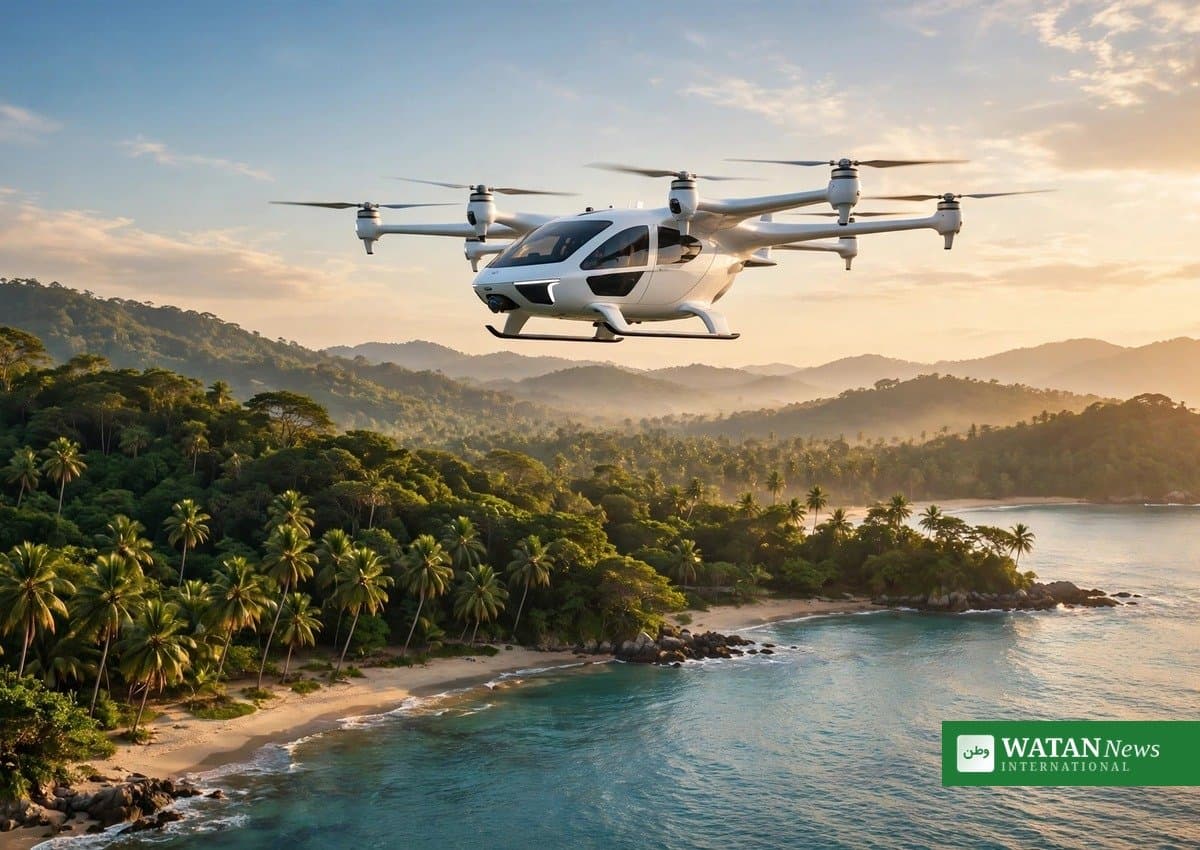
Sri Lanka’s first electric air taxi has arrived in the country, and its maiden flight is planned at Colombo Port City before the end of October 2026. According to the Civil Aviation Authority of Sri Lanka (CAASL), the two-seat, pilotless electric aircraft will first take to the skies in a demonstration flight, with commercial tourist services — including scenic flights over Sigiriya and Pidurangala — proposed to follow once safety and regulatory approvals are complete.
The arrival moves a project announced only two months ago into its flying phase. In August, Sri Lanka became the first country in the world to adopt the Global Fast Track Program of the Chinese aviation company EHang, which aims to bring pilotless electric vertical take-off and landing (eVTOL) aircraft into commercial service through a sequence of regulatory checks, ground preparation and validation flights.
For green travel, the flight is a milestone: electric aircraft produce no exhaust emissions in the air, offering a zero-emission alternative for short tourist hops that would otherwise be flown by conventional aircraft or made by road.
The project: from August talks to an October first flight
The main dates tell a fast-moving story. On 18 August 2026, ministry-level discussions chaired by Sri Lanka’s Minister of Ports and Civil Aviation, Anura Karunathilaka, examined passenger drone tourism, regulatory requirements and possible emergency and maritime applications.
On 19 August 2026, EHang announced its Global Fast Track Program, naming Sri Lanka as its first market and setting a conditional target of initial commercialisation within four months — around December 2026.
By 18 October 2026, CAASL announced that the passenger drone had arrived in Sri Lanka. The maiden flight at Colombo Port City is now planned for before the end of October.
CAASL’s director general and chief executive officer, Capt. Daminda Rambukwella, explained the conditions attached to the commercial target in the company’s announcement:
“The four-month target reflects the proposed implementation timeline and remains subject to the successful completion of the required regulatory, technical, operational, and safety assessments and approvals.”
Port City Colombo is to host the country’s first eVTOL sandbox — a designated zone where the authority can assess the technology and its operating arrangements before approving broader use. CAASL inspectors are working with EHang on airspace, aircraft requirements, maintenance, staffing and infrastructure, alongside the Ministry of Defence, the Sri Lanka Air Force and the Telecommunications Regulatory Commission.
Why the electric air taxi matters for green travel
An eVTOL aircraft rises and descends vertically on electric power, with no runway and no combustion engine. During flight it emits no exhaust gases — a direct climate advantage over helicopters and small aircraft burning aviation fuel.
The aircraft described in the August discussions carry two passengers, use 16 propellers, 12 battery modules and three flight-control systems that provide backups, with centralised management supported by artificial intelligence. The quoted endurance is about 30 minutes in the air — enough for short sightseeing loops and airport transfers.
Proposed services put tourism at the centre: scenic flights around Sigiriya and Pidurangala, tourist mobility within Port City and greater Colombo, and shuttles between Bandaranaike International Airport in Katunayake and hotels in central Colombo. At full occupancy, each departure carries two people, so the service is aimed at small groups and premium visitors rather than mass transport.
EHang says its EH216-S aircraft holds a type certificate, production certificate and standard airworthiness certificate from the Civil Aviation Administration of China, operates commercially in China, and has safe flight records across 23 countries. Those are company statements; Sri Lanka’s authorities are running their own assessments of the aircraft, procedures and infrastructure before any commercial approval.
Electric flight and cleaner fuel: where 2026 stands
Sri Lanka’s project is part of a wider 2026 push to cut the climate cost of travel. On 14 October 2026, the International Air Transport Association (IATA), Airbus and Accenture released a market study estimating that corporate purchases of sustainable aviation fuel (SAF) environmental-attribute certificates could support between 1.0 million and 1.9 million tonnes of SAF by 2030, up from an estimated 323,000 tonnes in 2024 — a strong demand signal for scaling up SAF production.
The same study notes the scale of the challenge: global SAF production in 2026 is expected to be just 2.4 million tonnes, or 0.8% of total jet fuel use, and SAF remains two to three times more expensive than conventional jet fuel. “SAF is aviation’s most important decarbonization lever, but airlines cannot shoulder the cost of scaling it up alone,” said Marie Owens Thomsen, IATA’s Senior Vice President Sustainability and Chief Economist.
Governments are acting too. Singapore’s Civil Aviation Authority (CAAS) has started a SAF levy for origin-destination passengers and general and business aviation flights, for tickets sold from 1 October 2026 on flights departing Singapore from 1 January 2027. All levies collected go into a statutory SAF Fund used to purchase SAF and related environmental attributes, with the non-profit SAFCo — wholly owned by CAAS — acting as collection agent.
Elsewhere, electric flying is edging toward passengers: Surf Air Mobility has placed a firm order for 25 BETA ALIA CTOL electric aircraft for inter-island service in Hawaii, starting with cargo and carrying passengers only after certification, and BETA has been running demonstration flights from Honolulu since late June 2026. In cruise travel, TUI Cruises’ Mein Schiff Relax and Mein Schiff Flow now operate primarily on bio-LNG, which the company expects to cut about 50,000 tons of CO2 equivalent per year — while analysts note the real saving depends on full lifecycle accounting of the fuel. And in Malta, Norwegian Cruise Line Holdings signed a shore power agreement with Transport Malta in October, allowing berthed ships to plug into the island’s grid instead of running their engines.
FAKTA
- What: Sri Lanka’s first passenger transport drone (pilotless electric eVTOL) has arrived in the country.
- Maiden flight: Planned at Colombo Port City before the end of October 2026, according to CAASL.
- Capacity: Two passengers, about 30 minutes of flight time.
- Proposed services: Sightseeing flights over Sigiriya and Pidurangala, airport-to-hotel shuttles, tourist mobility in Port City and Colombo.
- Commercial target: Initial sandbox commercialisation within four months of August 2026 — conditional on all regulatory, technical, operational and safety approvals.
- Climate angle: Electric aircraft produce no exhaust emissions in flight, offering zero-emission short tourist hops.
What happens next
The next scheduled milestone is the Port City flight itself. After that, the project’s stated pathway calls for validation flights and operational approval before commercial passenger services can begin. Authorities have not announced an exact maiden-flight date, fares, a final route network, fleet size or ticket prices — those details will determine what travellers can actually book.
Minister Anura Karunathilaka, who also serves as Sri Lanka’s energy minister, described the government’s objectives in EHang’s announcement: “Sri Lanka is actively embracing emerging aviation technologies to transform our tourism industry, strengthen emergency response capabilities, and meet maritime logistics and coastal service needs.” Emergency response, coastal services and unmanned maritime cargo logistics are also being explored beyond tourism.
For more on how travel is getting greener, see Watan News’ climate news coverage.