
Bonito, in the Brazilian state of Mato Grosso do Sul, has launched the Bonito climate action plan for 2025–2030 — presented as Brazil’s first climate action plan for a tourism destination built on a verified emissions inventory, performance indicators and measurable decarbonization targets.
The plan was unveiled on October 1, 2026, at ABAV Expo 2026 in São Paulo, Brazil’s largest tourism fair, which ran from September 30 to October 2, 2026. It was coordinated by GI International together with the Municipality of Bonito and the Mato Grosso do Sul Tourism Foundation (FUNDTUR MS), according to GI International, the plan’s coordinator.
Key Facts
- Plan: Plano de Ação Climática do Destino Turístico de Bonito 2025–2030
- Launched: October 1, 2026, at ABAV Expo 2026 in São Paulo
- 2021 baseline: 9,486.28 tCO₂e total; 46.17 kgCO₂e per tourist
- 2030 target: at least 20% fewer emissions per tourist than in 2021 (no more than 36.94 kgCO₂e)
- Progress: 2023 — 44.02 kg (−4.65%); 2024 — 48.26 kg (+4.52%)
- Coordinators: GI International, Municipality of Bonito, FUNDTUR MS
What the Bonito climate action plan contains
The launch panel was moderated by Bruno Wendling, president of FUNDTUR MS, with representatives of UN Tourism, Embratur, Brazil’s Ministry of Tourism, Bonito’s Secretariat of Tourism and Economic Development (SECTUR) and GI International.
Bonito is the world’s first carbon neutral ecotourism destination, with three certification cycles (2021, 2023, 2024). Mayor Josmail Rodrigues said planning for the climate “means planning for the long-term future of the destination’s tourism and residents’ quality of life,” according to the municipality’s announcement.
The numbers behind the target
In 2021, the tourism destination’s footprint stood at 9,486.28 tCO₂e — 46.17 kgCO₂e per tourist. Bonito received 205,460 tourists that year, with an average stay of 3.8 days.
The 2030 target is to cut emissions per tourist by at least 20% compared with 2021 — no more than 36.94 kgCO₂e. In 2023, 313,316 tourists visited with 44.02 kg per tourist (−4.65% against the baseline), while 2024 brought 290,806 tourists and 48.26 kg (+4.52%) — which means a 23.46% improvement is now needed from 2024 levels.
The main emission sources are road vehicle fuel (about 53%), solid waste decomposition (about 14.5%), fuel production (about 13.8%) and electricity (about 11.3%).
Five lines of action
Energy transition and mobility
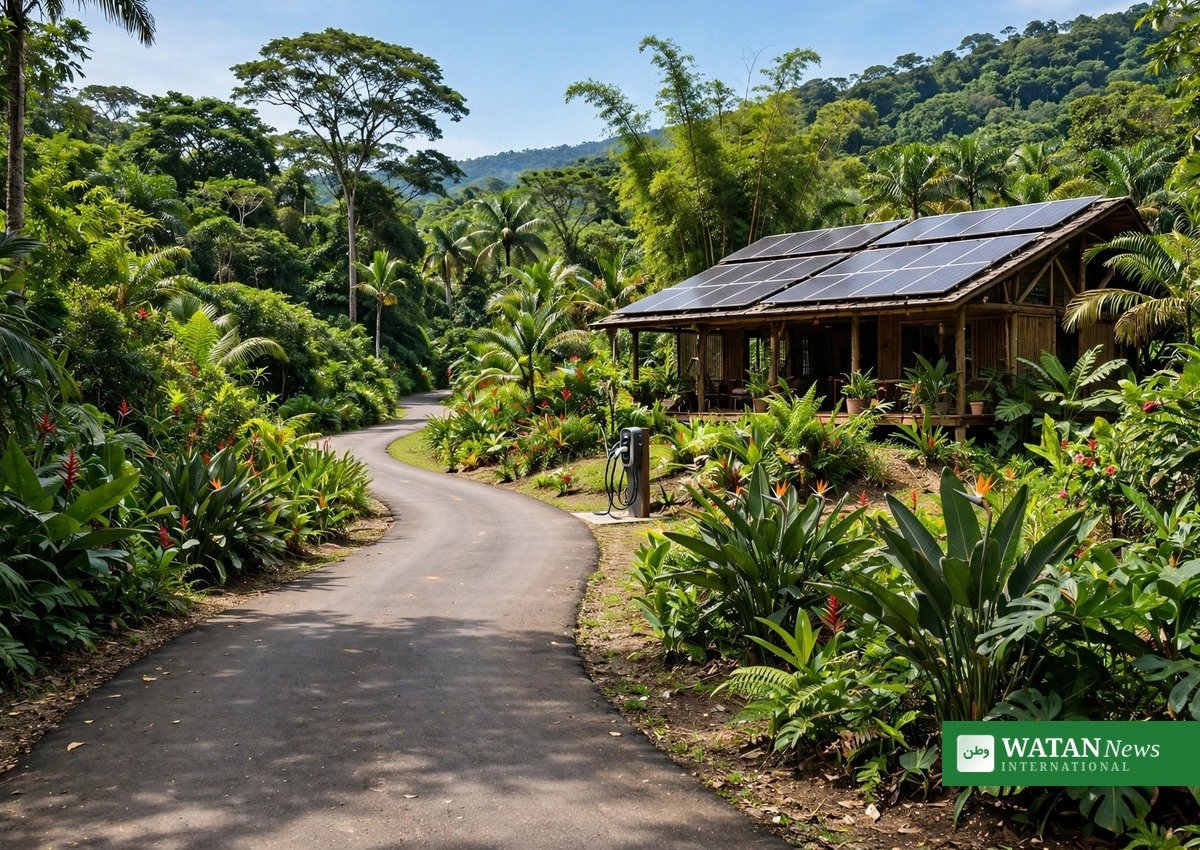
Ethanol, electric vehicles, solar power, 15.5 km of existing bike lanes and EV charging points at attractions.
Solid waste and circular economy
Composting — 473 tonnes of organic waste processed in 2024 — a Zero Waste certification drive, and selective collection reaching 100% of the urban area by 2030.
Ecosystem regeneration and reforestation
Linear parks and seedlings from the municipal nursery, with a target of 20,500 seedlings per year by 2030.
Climate education and tourist engagement
Schools, regenerative tourism and low-carbon events.
Cross-cutting allies and investment
A cross-cutting line bringing together allies and investment across all sectors.
When climate change hits the destination
Between January 31 and March 29, 2023, heavy rain and flooding forced the Balneário Municipal attraction to close for 48 days — just 854 visitors and R$ 58,378 in revenue, compared with 7,343 visitors and R$ 370,892 in the same period of 2022.
A model aligned with global tourism commitments
The plan is aligned with the Glasgow Declaration on Climate Action in Tourism, coordinated by UN Tourism, which Mato Grosso do Sul has signed since 2023. It also feeds into the state goal of carbon neutrality by 2030 and forms part of the Bonito Ecocriativa Smartcity strategy.
With COP30 held in Belém in November 2025, Brazil moved to the center of the global climate agenda — and Bonito’s plan is a concrete, verifiable case of climate action in tourism.
In the plan’s foreword, Bruno Wendling and Flávia Neri de Moura write: “A climate transition is urgent, and the cost of not investing today will be even greater.”
Read more about climate action in tourism in our latest climate stories.
Conclusion
Bonito’s plan shows that tourism destinations can lead on climate action — a green travel model the world can learn from.